
Archaeological Museum
The museum houses some excellent works of art, such as the famous Liver of Piacenza and the imposing draped statue by the Athenian sculptor Kleoménes.

The archaeological section opens on the ground floor of the Visconti Citadel, with a room dedicated to the collectors who created the first archaeological collections and whose impetus helped create the city's museums.
The other rooms present the most ancient phases of prehistory , up to the middle of the fourth millennium BC and illustrate the cultures, the economic-social organisation and the spiritual world of human groups from the Copper Age to Romanisation (3400-2nd century BC).
Descending into the scenic undergrounds of the Visconti Citadel and Palazzo Farnese, the Roman Section unfolds across 15 rooms.
The tour begins with a geographical and chronological overview of the era, focusing on archaeological discoveries and methodology, and concludes with a video retracing the most significant stages in the city's history.
The book covers a variety of topics: the pre-existing structures in the Piacenza area before Roman colonization; the foundation, urban plan, and institutions of the new Roman city; the economy, trade, production, and the role of the Po River; residential construction and daily life; cults and religious buildings; funerary monuments and necropolises; the end of the Roman world and the transition to the Early Middle Ages. 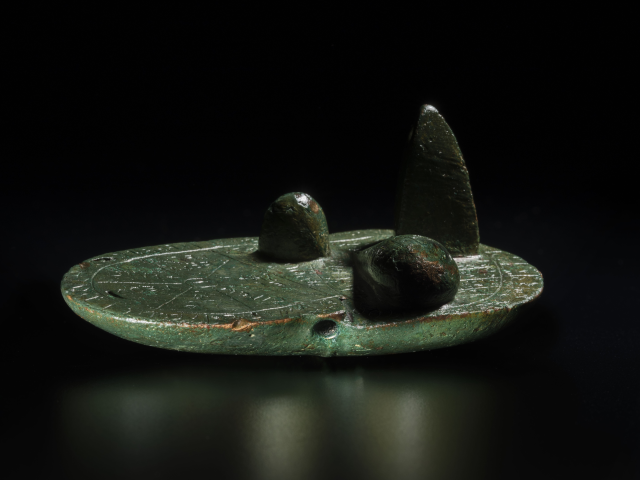 The Roman Section features some outstanding works of art, such as the famous Liver of Piacenza and the imposing draped statue by the Athenian sculptor Kleoménes, both enhanced by the new display. These works also include important previously unseen finds that shed light on the city and reconstruct life in Roman Placentia. ( ON LOAN - From May 2 to September 20, 2026, the unique Etruscan find will be one of the highlights of the international exhibition “ The Etruscans: From the Heart of Ancient Italy, ” at the Legion of Honor Museum , part of the Fine Arts Museums of San Francisco .)
Among these is an extraordinary funerary bed , reconstructed in wood and with a bovine bone covering in Hellenistic style, which was part of the furnishings of the tomb discovered in the Cantone del Cristo area during the excavations for the construction of a new department of the Guglielmo da Saliceto hospital and the Antefixes, or the final decorative elements of the temple tiles, of Hellenistic-Oriental culture, discovered in 1947 and 2000, which have allowed us to reconstruct the ornamental apparatus of a temple, probably located in the northern part of Piacenza, a Roman colony.
In the room dedicated to the Roman domus, you can admire elegant floor mosaics and everyday objects, such as fragments of furniture and lamps, writing instruments, balms for ointments and perfumes, containers for makeup and personal ornaments, tools for household care, spinning and weaving, and remains of board games, including a terracotta chessboard from the 2nd-3rd century AD.
Even the funerary monuments, with their size and the richness of their decorations, testify to the rank of the deceased; for example, a winged Sphinx is on display, a decorative element of an aedicule funerary monument, which certainly belonged to an eminent family.
Also interesting are the finds in the last room which testify to the city's passage under Lombard domination , including a gold tremissis - a coin from the late Roman Empire - minted in Piacenza between 712 and 744 during the reign of Liutprand.
Translated by AI

