
While the Greeks considered them fearsome pirates, Latin historians and writers remember the Etruscans above all for their religiosity, giving us the image of a "people more than any other devoted to the practices of worship" (Livias, Alb nrbe condita, V 1,6) .
This tradition, in reality, reflects the point of view of the ruling class at the end of the Republic and the beginning of the Empire, when the practice of some disciplines of the Etruscan religion was considered indispensable in the official ritual of the Roman state.
Etruscan theology differs from that of other ancient Mediterranean religions in its particular emphasis on divine inexplicability; this is also why the Romans appealed to the haruspices of Etruria in the case of monstra , abnormal and inexplicable natural manifestations.
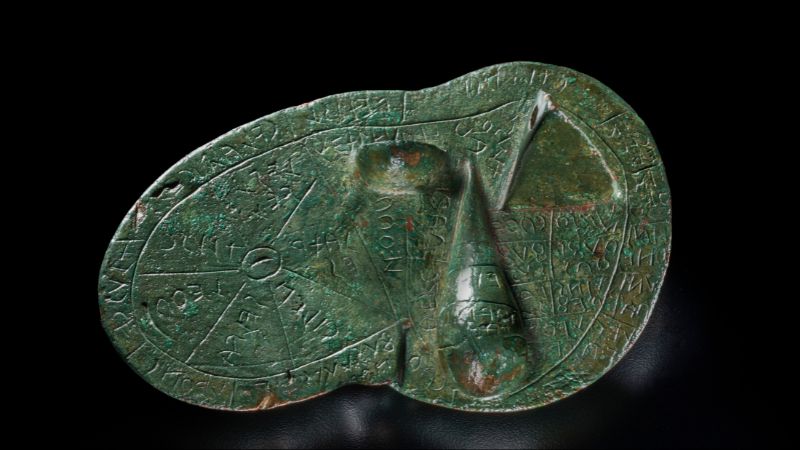
It is possible to reconstruct the cosmological vision of the Etruscans thanks to some precious sources, among these the very important Liver of Piacenza .
This is a small bronze sculpture, cast using the lost wax process, made in northern Etruria between the end of the 2nd and the first half of the 1st century BC , when Etruria was already under Roman rule and colonies, including Placentia , were prospering in the Po Valley.
While much has been understood about the Liver, several questions remain partially unresolved, first and foremost the reason for its discovery in the Piacenza area.
Before reconstructing the true extent of the Etruscan presence in the Piacenza area, the hypothesis had been put forward that it was a practical model lost by a haruspex in service with the Roman army.
In fact, in light of recent discoveries attesting to the Etruscan presence in our territory as early as the 6th century, the hypothesis of the persistence of Etruscan groups surviving in the area until Romanization cannot be ruled out.
Its function also remains uncertain, and in the absence of information on the context of its discovery, various hypotheses have been put forward: at one time, it was considered a teaching tool for liver surgery, a professional reminder for haruspices, or an element belonging to an honorary statue. The excellent preservation of the artifact, which must not have been used for long, suggests that it may have been part of a funerary object or a votive offering in some sanctuary.
What is certain is that the find, discovered near Gossolengo, in the province of Piacenza, on 26 September 1877 and donated to the Civic Museum of Piacenza in 1894, has always held great fascination for scholars and enthusiasts, still giving rise to countless attempts at interpretation today.
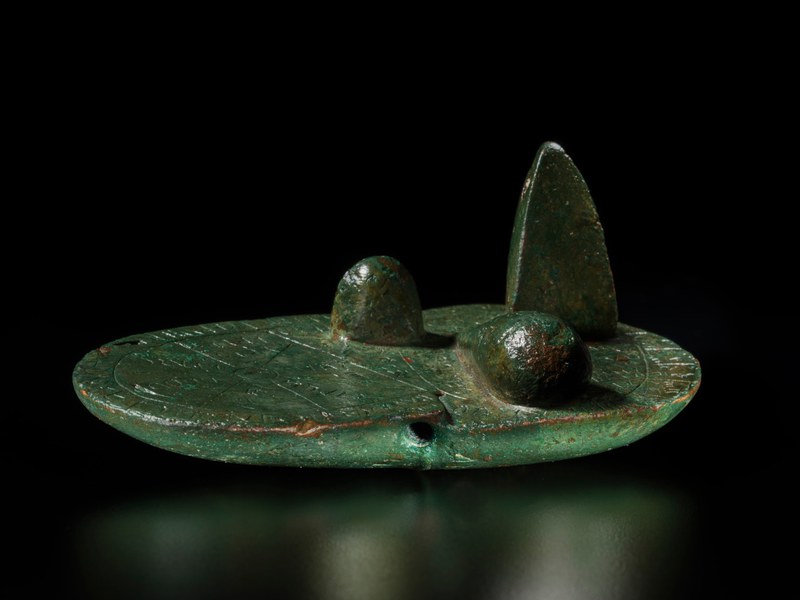
The precious find is housed in a room dedicated to it in the Archaeological Museum of Palazzo Farnese.
From May 2 to September 20, 2026, the unique Etruscan find was one of the protagonists of the international exhibition “The Etruscans: From the Heart of Ancient Italy,” at the Legion of Honor Museum , part of the Fine Arts Museums of San Francisco .)
The English translation of this text was generated by artificial intelligence. The official version is available in Italian.